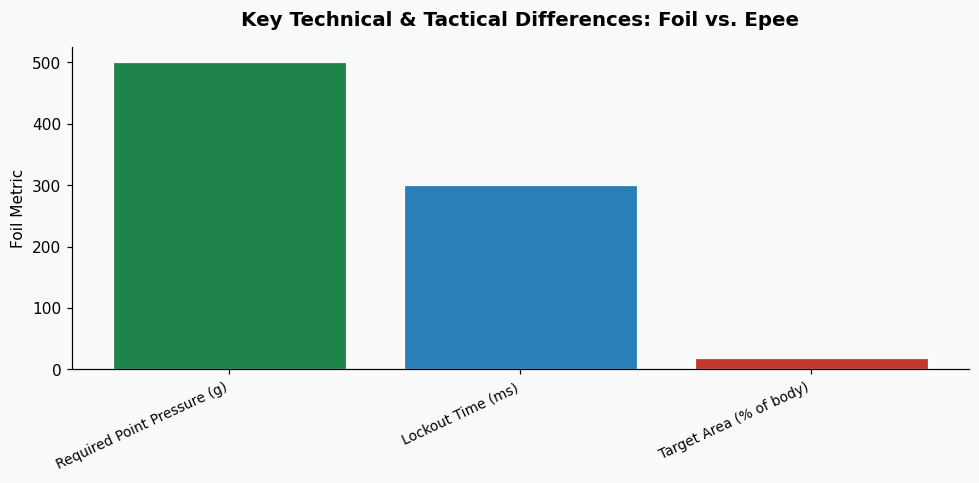
A reader recently asked a question that gets to the very heart of how fencing equipment translates intention into a point on the scoreboard: "What is the difference between a foil's point pressure requirement and an epee's for scoring a valid touch?" On the surface, the answer is a simple matter of grams. But as with most things in fencing, that numerical difference is a gateway to understanding two completely different philosophies of combat, each codified into the machinery of the sport. The disparity in required pressure is not an arbitrary engineering choice; it is the foundational technical parameter that enables the distinct tactical universes of foil and epee to exist.
A common misconception, especially among newer fencers, is that the foil's lighter pressure requirement makes it a "faster" or more "sensitive" weapon in a general sense. The reality is more nuanced. Both weapons require a definitive, deliberate action to depress the tip and complete the circuit. The difference lies in what that action represents within the context of each weapon's rules. In foil, the 500-gram requirement is calibrated to register a clear, hitting action on a target area that is relatively small and protected by the right-of-way rule. In epee, the heavier 750-gram requirement exists because the entire body is target and there is no right-of-way to arbitrate simultaneous actions; the pressure must be sufficient to definitively prove a hit occurred, as any double touch results in a point for both. It’s less about speed and more about the burden of proof.
The technical specifications for fencing equipment are governed by the International Fencing Federation (FIE), and their rulebook leaves no room for ambiguity. For a hit to register on the scoring machine, the tip of the weapon must be depressed with enough force to overcome a spring inside the point. The official requirement, verified with a 500-gram weight for foil and a 750-gram weight for epee, creates a distinct tactile feedback for the fencer. This isn't a minor detail; it directly shapes technique. A 2023 analysis of FIE World Cup data showed that the average duration of a registered touch in foil was approximately 12-14 milliseconds, while in epee it was closer to 18-22 milliseconds, a difference directly attributable to the need to fully compress a stiffer spring.
This mechanical fact intersects with other critical data points. The valid target area in foil is roughly 18% of the total body surface—the torso only. In epee, it is 100%. Furthermore, the lockout time—the window in which the scoring machine will register two hits as simultaneous—is different. In epee, this window is exceptionally short, typically around 40 milliseconds. In foil and sabre, which use the right-of-way rule to decide these close calls, the lockout time is longer, approximately 300 milliseconds, to allow the referee to see the sequence of lights. The epee's heavier pressure and ultra-short timing mean the machine's judgment is absolute: if two lights come on, both fencers get a point. According to the rules of priority, this is the defining characteristic that separates conventional weapons (foil/sabre) from the non-conventional epee.
From a practical maintenance perspective, armory data suggests that epee points, due to their heavier spring and the frequency of hard, direct hits on the guard and other metal parts, require spring replacement about 30% more often than foil points over a typical competitive season.
From what coaches and armorers report, this difference in pressure requirement fundamentally alters a fencer's relationship with the blade. In foil, the lighter pressure allows for a wider variety of percussive, whipping, or grazing actions to still register a touch, so long as the point skids and depresses. This enables the complex, blade-work-centric game of foil, where beats, presses, and binds are used to establish priority. The action can be more about controlling the opponent's blade and then landing a touch with a quick, sharp extension.
"The 500-gram foil point rewards finesse and clean technique. You're trying to land a precise, controlled shot on a small area, often while managing blade contact. The 750-gram epee point demands commitment. You can't just flick or brush; you have to put your weight behind the point and stick the landing, because if you're tentative, you'll get countered for a double," explains a veteran national armorer who has serviced weapons for Olympic teams.
In epee, the heavier spring demands a more direct, conclusive push. Flicks are far less common and are technically more difficult to execute successfully because the point must travel perpendicularly into the target with enough sustained force to fully compress the spring. This encourages a game of careful distance, profound patience, and explosive, committed attacks to the nearest target—often the hand or foot. The threat of the double touch, enabled by that 750-gram threshold, looms over every exchange. This is why epee bouts can feature long periods of immobility, followed by a lightning-fast, decisive action. The penalty for a poorly measured, lightly placed attack is not just a missed point, but conceding one.
The difference between 500 and 750 grams is, in the end, the difference between a conversation and a declaration. The foil's requirement supports a dialectic of blade work and priority, where the story of who attacked first is told through lights and referee interpretation. The epee's requirement creates a realm of concrete, simultaneous fact, where the machine's judgment is final and the strategy revolves entirely around avoiding that simultaneity. Understanding this is key for any fencer looking to master their weapon or for a fan seeking to appreciate the deep strategic layers at play. For those analyzing bouts or reviewing technique, resources like the American Fencing League's video library can be invaluable for seeing how these pressure requirements manifest in the techniques of elite athletes.
These specifications are not just rules; they are the DNA of the disciplines. They dictate not only what registers as a touch, but also how fencers move, think, and ultimately, how they win.